


How Aluminum Casting Shapes the Automotive and Aerospace Industries
Aluminum casting is very central in the production of components used in the automotive industry as well as aerospace. Its light weight characteristics, durability and molding capability to complex shapes have made this a reliable option in manufacturing parts in these performance production industries. Whether it is the shaving off of pounds or the improvement in the fuel efficiency, aluminum casting still goes on to redefine the manner in which vehicles and aircrafts are made.
The Knowledge of Aluminum Casting
Central to the process is the aluminum casting, which entails the placement of molten aluminum into a mold in order to mold a particular part or shape. The aluminum casting procedure may be in a number of forms, which include sand casting, shell molding, or die casting supplier, and each of them has its own advantages in relation to the component being produced.
Aluminum casting has been of great importance in the automotive industry to make lightweight, but powerful components. The automakers are continuously trying to find ways on how to decrease the total weight of their cars to achieve a higher standard of fuel efficiency and emissions.
The superior strength to weight ratio of aluminum enables the manufacturers to make high performance components like the engine blocks, transmission cases, wheels and structural parts. This weight loss does not only help to make the vehicle more fuel efficient, but also makes the vehicle have better performance and handling.
The Aluminum Casting in the Auto Industry
One of the most popular forms of aluminum casting is the die casting aluminum which is especially popular in high volume production. In Aluminum casting process, high pressure of molten aluminum is injected in the mold made of steel. The outcome is a very accurate and standardized part that is crucial to components that must be of high quality and reliability. Through die casting, complicated designs which include thin walls and complex geometries can be designed without sacrificing the strength of the part.
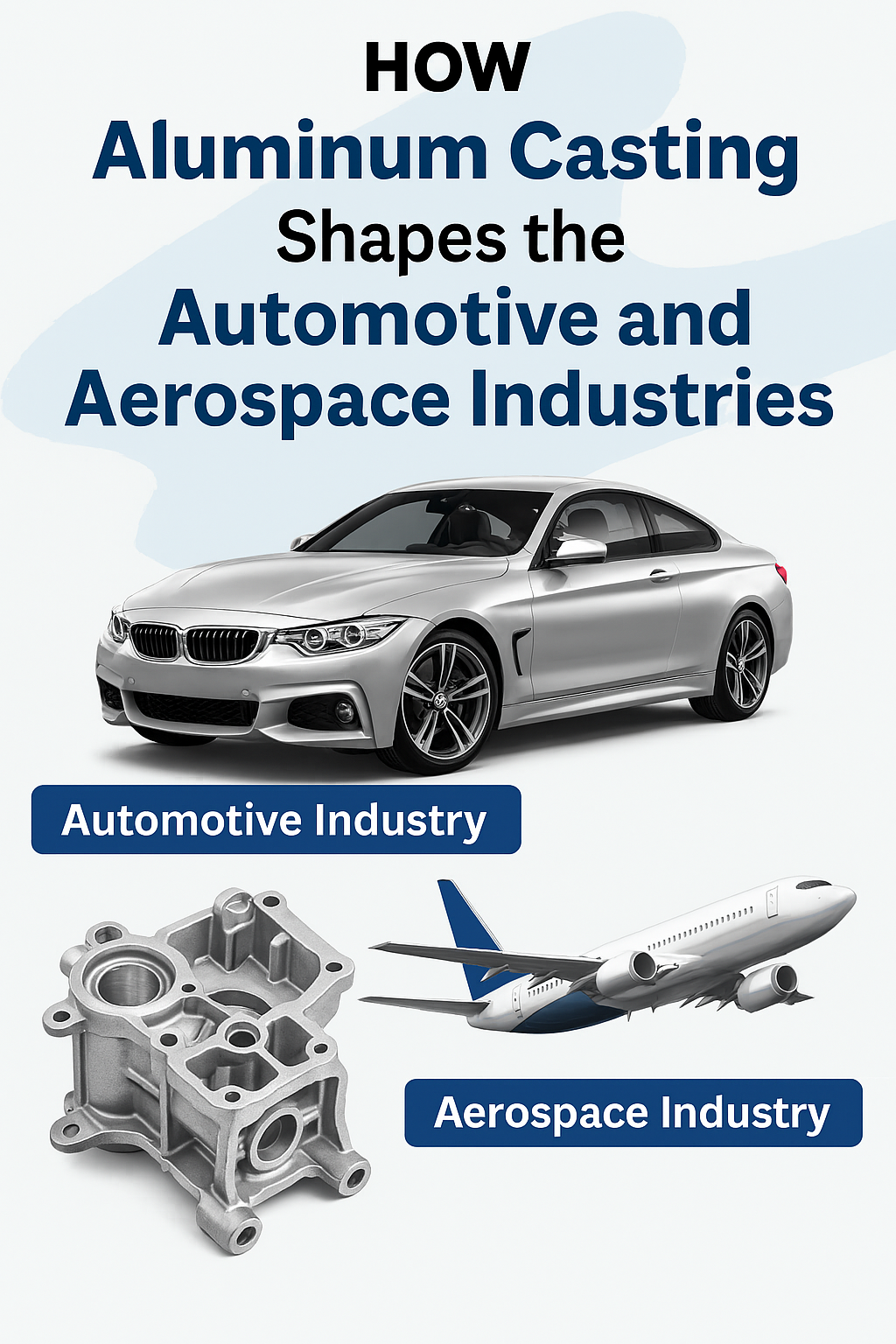
Indicatively, in the present cars, aluminum die casts are utilized in all aspects of the engine block including the cylinder head and suspension components as well as the interior parts such as door handles, seat frames and even components like door handles and seat frames. The capacity to cast these components in large volumes, precision, and material qualities has seen aluminum casting become an option of choice to automakers.
The Aerospace Industry of Aluminum Casting
The advantages of aluminum casting are also very high in the aerospace industry. Weight reduction comes as one of the priorities particularly when coming up with aircraft components that are to endure high stress and under extreme conditions. Aluminum casting enables aerospace engineers to make parts of turbine blades, structural supports, and even engine components which are lightweight and strong enough to withstand the stringent safety requirements.
In aerospace, Aluminum casting process is usually more complicated because the parts have to resist greater temperatures and pressure. Particular procedures such as investment casting (a form of aluminum casting) are employed in manufacturing parts of the required precision and strength. On numerous occasions, aluminum has been a preferable material because of its resistance to corrosion and its capacity to create complex shapes, which is why it is a good material in a situation where strength and reliability cannot be compromised.
The Future of Aluminum Casting in the Automotive and Aerospace
With the further development of the sphere of technologies, more efficient, light, and durable parts are in demand. Aluminum casting will also have a bigger part in the automotive and aerospace industry. More production steps can be optimized with new methods in casting, such as 3D printing using aluminum alloys, which can provide even greater accuracy and ability to design.
The aluminum casting will not be left behind in the further development of such industries, assists manufacture of lighter, faster and more fuel-efficient vehicles and aircraft and achieve the constantly growing performance and safety requirements.
Read Also: Lock Nut v/s Hex Nut: Which one Should You Choose?